
What “Totally Enclosed Fan Cooled” Really Tells You About a Motor
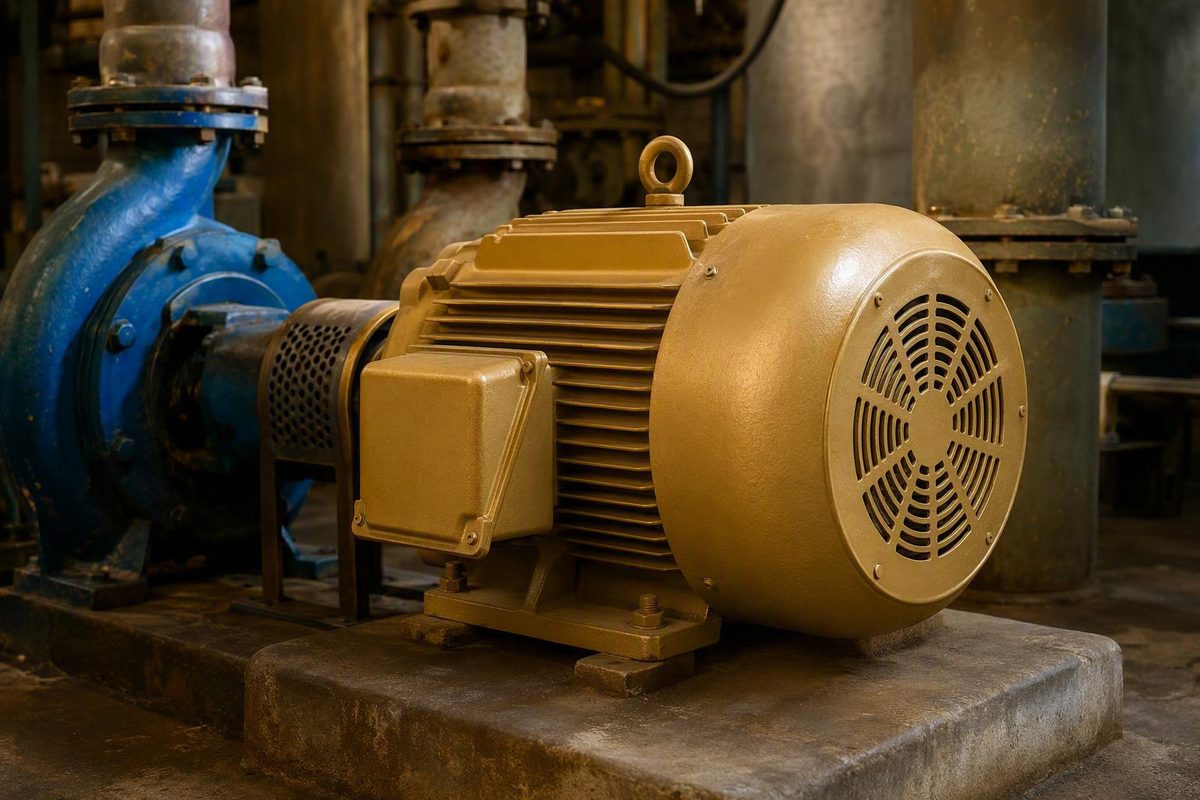
TEFC Meaning in One Sentence
TEFC stands for “Totally Enclosed Fan Cooled”: it describes an electric-motor enclosure and cooling arrangement in which ambient air does not circulate freely through the motor interior, while an integral fan moves cooling air over the outside of the frame. “Totally enclosed” does not mean airtight in this context (TECO-Westinghouse enclosure reference).
The designation combines two ideas:
- Totally enclosed: The enclosure restricts free air exchange between the motor interior and the surrounding environment.
- Fan cooled: A fan forces ambient air across the motor’s exterior surface to carry heat away.
TEFC tells you how the motor is enclosed and cooled. It does not state the motor’s horsepower, speed, voltage, efficiency, service factor, duty, frame size, ingress-protection rating, or hazardous-location approval. Those characteristics must be confirmed elsewhere on the nameplate or in the manufacturer’s documentation.
On a NEMA-style nameplate, TEFC may appear in a field marked ENCL or enclosure. That field is only one part of the mechanical, electrical, and dimensional information needed to identify and apply a motor correctly (ABB guide to NEMA motor nameplates).
A useful shorthand is:
The motor does not use a free flow of surrounding air through its windings for cooling. Instead, a fan cools the motor from the outside.
That distinction often matters for pumps, blowers, conveyors, farm equipment, manufacturing machinery, and other equipment exposed to dust, dirt, dampness, or airborne contaminants.
How a TEFC Motor Stays Cool
At first, “totally enclosed” and “fan cooled” can sound contradictory. If outside air does not pass freely through the motor, how does the fan remove heat?
The fan cools the enclosure, rather than directing ambient air through the windings.
During operation, heat reaches the motor housing. The housing—and any exterior fins or ribs—provides surface area from which that heat can pass to the surrounding air. An external fan moves air over those surfaces, improving heat removal.
The fan is commonly located at the rear of the motor beneath a protective cover. In a typical design, it is mounted on and driven by the motor shaft. The airflow passes over the housing or cooling fins instead of entering the motor’s electrical interior (TEFC and TENV cooling comparison).
The external airflow can be pictured as follows:
Ambient air enters around the fan-cover openings → the fan accelerates it → air travels along the exterior frame and fins → heat passes from the frame into the moving air → warmed air disperses into the surroundings.
Openings in the fan cover do not mean that air is being drawn through the motor’s windings. Those openings serve the external fan and help direct air along the outside of the frame.
Cooling fins are useful because they increase the exterior surface area exposed to moving air. Frame shapes vary, but longitudinal ribs or fins are a common visual feature of TEFC motors.
This is what fan cooled means in TEFC: forced airflow over the motor’s outside surface. It does not normally mean that the external fan pushes ambient air through the windings, as an open motor’s ventilation arrangement may do.
The external airflow path must remain available. A nearby wall, guard, debris layer, stored material, or other obstruction can interfere with air movement around the fan cover and frame. Enclosed construction reduces direct internal exposure to contaminants, but it does not eliminate the need for exterior cooling.
What “Totally Enclosed” Does—and Does Not—Mean
“Totally enclosed” has a narrower technical meaning than it does in ordinary conversation. It means that the enclosure prevents the free exchange of air between the inside and outside of the motor. It does not require a hermetic or airtight enclosure (TECO-Westinghouse enclosure reference).
Ingress protection and hazardous-location suitability are separate specification layers. ABB’s nameplate guidance treats enclosure type and International Protection information as distinct data used to identify a motor’s construction and environmental protection (ABB nameplate and enclosure guidance).
A TEFC label alone therefore does not establish that a motor is:
- Waterproof or watertight
- Submersible
- Suitable for hose-directed or high-pressure cleaning
- Approved for a wet location
- Corrosion-resistant
- Approved for every outdoor installation
- Explosion-proof
- Approved for an atmosphere containing combustible gas, vapor, or dust
A particular TEFC motor may carry one or more additional ratings. Those capabilities come from the individual product’s design, markings, approvals, and instructions—not from the four-letter TEFC designation.
Myth versus fact
| Myth | Fact |
|---|---|
| “Totally enclosed” means airtight. | It means the enclosure restricts free air exchange. It does not necessarily form a hermetic seal. |
| Every TEFC motor is waterproof. | Water protection depends on the individual motor’s ingress rating and manufacturer approval. |
| Any TEFC motor can be pressure-washed. | Washdown or high-pressure cleaning requires explicit product-level suitability. |
| TEFC automatically means outdoor-rated. | Outdoor suitability depends on the complete rating, installation, exposure, orientation, drainage, and manufacturer instructions. |
| TEFC means explosion-proof. | Hazardous-location approval is separate and must match the particular location involved. |
| A drain means the motor cannot be TEFC. | Some TEFC designs include controlled condensation drains because “totally enclosed” does not mean hermetically sealed. |
Condensation drains illustrate the limits of the word “enclosed.” Some TEFC motors include drain holes or removable plugs intended to release collected condensation. A controlled drain does not create the free through-flow ventilation associated with an open motor.
Drain position, plug configuration, and mounting orientation are model-specific. They should be handled according to the motor manufacturer’s instructions rather than a universal rule.
The practical lesson is simple: treat TEFC as an enclosure-and-cooling description, then verify environmental and location approvals separately.
TEFC vs. ODP vs. TENV
TEFC is easiest to understand when compared with two other common motor-enclosure abbreviations:
- ODP: Open Drip-Proof
- TENV: Totally Enclosed Non-Ventilated
The three designs differ mainly in how they interact with surrounding air and remove heat. ODP allows air circulation through the motor, TEFC uses an enclosed housing with an external fan, and TENV is enclosed without the external fan characteristic of TEFC (motor-enclosure comparison).
| Feature | ODP | TEFC | TENV |
|---|---|---|---|
| Basic enclosure | Open enclosure with guarded ventilation openings | Enclosure restricts free internal air exchange | Enclosure restricts free internal air exchange |
| Ambient air through interior | Yes; surrounding air can circulate through or around internal components | No free flow of ambient air through the motor interior | No free flow of ambient air through the motor interior |
| External cooling fan | Not the defining feature; cooling relies on ventilation through the motor | Yes; an integral external fan moves air over the frame | No external cooling fan |
| Primary cooling arrangement | Direct ventilation of internal components and surfaces | Heat reaches the frame, and fan-driven air cools the exterior | Heat leaves through the enclosure without a TEFC-style external fan |
| Relative contaminant exposure | Greater direct exposure because cooling air enters the motor | Less direct internal exposure than ODP | Less direct internal exposure than ODP |
| Typical selection context | Relatively clean, dry, protected spaces where an open motor is permitted | Dusty, dirty, damp, or contaminant-prone settings, subject to complete ratings | Enclosed applications where the specific motor’s thermal design does not require an external fan |
| Major limitation | Ventilation openings expose internal parts to surrounding air | The fan inlet and exterior airflow path must remain unobstructed; TEFC alone does not establish environmental approval | Output and thermal suitability depend on the particular fanless design and application |
An ODP motor has guarded ventilation openings and permits ambient air to circulate through or around internal components for cooling. This provides a direct ventilation path, but it also gives dust, humidity, and airborne material a more direct route toward the motor interior.
A TEFC motor restricts free internal air exchange. Its fan moves ambient air over the enclosure. Compared with ODP, this generally reduces the direct exposure of windings and other internal parts to dirt, moisture, and airborne contaminants.
A TENV motor is also totally enclosed, but it lacks the external cooling fan that defines TEFC. Whether a TENV motor is suitable depends on its design, rating, load, ambient conditions, and installation.
TEFC is not universally superior to either alternative. A clean, dry mechanical room may permit an ODP motor if the equipment specification allows it. Another application may use TENV because an external fan is unnecessary or undesirable. In a contaminant-prone environment, a suitably rated TEFC motor may be the more appropriate choice.
Do not use the enclosure acronym as a shortcut for efficiency, operating temperature, durability, or service life. Those comparisons require model-specific data, including duty, efficiency, temperature information, materials, load profile, and installation conditions.
Where TEFC Motors Commonly Fit
TEFC construction is commonly considered where an open motor would expose internal parts too directly to the surrounding environment. Relevant conditions may include:
- Airborne dust
- Dirt or fibers
- Agricultural debris
- Humidity or moderate dampness
- Oil mist or other airborne contaminants
- Outdoor exposure covered by the individual motor’s ratings and instructions
Common equipment examples include pumps, blowers, conveyors, manufacturing machinery, farm equipment, and material-handling systems. These examples show where TEFC motors may be found; they do not establish that every machine in those categories requires one.
For a pump installation, the enclosure decision should begin with the actual location. A motor in a dusty processing area faces a different environment from one in a clean, conditioned mechanical room. A motor above a sump faces different moisture exposure from one outdoors under a canopy. Chemical spray also introduces a corrosion question that TEFC alone cannot answer.
The basic advantage over an open enclosure is straightforward: because cooling air is not deliberately drawn through the interior, internal components have less direct contact with surrounding contaminants. That can be useful where airborne material would otherwise enter the motor or collect on internal surfaces.
Two bounded examples illustrate the point:
- Dusty workshop: A suitably rated TEFC motor may be preferable because it does not rely on workshop air flowing freely through the motor. Any combustible-dust classification must still be addressed separately.
- Clean, dry mechanical room: An ODP motor may be acceptable when the equipment specification and surrounding conditions permit an open enclosure.
Outdoor use requires product-level verification. TEFC motors are commonly discussed for outdoor or contaminant-prone applications, but the designation alone does not address every form of rain, condensation, drainage, corrosion, temperature, or installation orientation (TEFC and ODP application overview).
The same caution applies to “damp” locations. Humid air, occasional condensation, dripping water, spray, hose cleaning, and continuous saturation are not equivalent exposures.
Choose from the environment outward:
- Describe the dust, contaminants, moisture, and water exposure.
- Identify the ambient and operating conditions.
- Determine whether the area has a hazardous-location classification.
- Check the equipment manufacturer’s motor requirements.
- Select a motor whose complete ratings cover those conditions.
The acronym is a useful filter, not the final decision.
How to Verify Environmental Suitability
Before installing a TEFC motor outdoors, around water, in a washdown area, or in a potentially hazardous atmosphere, check three sources for the exact model:
- The motor nameplate
- The manufacturer’s current data sheet
- The installation, operation, and maintenance manual
Do not rely on a seller’s category label, a catalog photograph, or the word TEFC alone.
Enclosure and environment checklist
- Enclosure designation: Does the nameplate state TEFC in the ENCL field or equivalent specification?
- Ingress rating: What product-specific IP or other ingress rating is listed?
- Outdoor suitability: Does the manufacturer permit the proposed exposure, mounting position, and orientation?
- Wet-location suitability: Are the expected rain, drip, splash, condensation, or other water conditions covered?
- Washdown approval: Is the motor approved for the actual cleaning method?
- Corrosion resistance: Are the frame, shaft, fasteners, fan cover, coating, and connection arrangement suitable for the atmosphere?
- Hazardous-location classification: Does the motor carry the approval and markings required for the classified gas, vapor, or dust location?
- Ambient limits: Are the expected operating temperatures within the motor’s stated limits?
- Duty: Is the motor rated for the intended running time, starting pattern, load, and operating cycle?
- Installation instructions: Are orientation, drainage, guarding, ventilation clearance, and wiring consistent with the manual?
An ingress rating is separate from TEFC. It addresses protection involving contact, solids, dust, and water. No particular IP code can be inferred from TEFC alone; use the rating assigned to the exact motor.
Installation details can also matter. Cable entries, conduit arrangements, drains, mounting, and shaft orientation must follow the manufacturer’s documentation for the completed installation.
Require explicit product-level suitability for:
- High-pressure or high-temperature cleaning
- Hose-directed washdown
- Partial or full submersion
- Corrosive or salt-laden exposure
- Combustible-dust atmospheres
- Flammable-gas or vapor atmospheres
TEFC motors are not inherently protected against high-pressure water or submersion, and TEFC does not by itself mean explosion-proof (TEFC enclosure limitations).
A motor can truthfully be described as TEFC and still be unsuitable for a particular outdoor, wet, washdown, submerged, corrosive, or hazardous installation. The complete specification and applicable approval—not the acronym—settle that question.
How to Identify a TEFC Motor
Start with the nameplate or data sheet. Appearance can suggest TEFC construction, but it cannot confirm the designation or environmental ratings.
On a NEMA-style nameplate, look for a field labeled:
- ENCL
- ENCLOSURE
- An equivalent enclosure or cooling field
The value may read TEFC. A Baldor-Reliance nameplate guide shows ENCL. as a distinct field alongside frame, horsepower, speed, voltage, amperage, duty, efficiency, and other motor data (Baldor-Reliance nameplate guide).
Common visual clues include:
- A fan cover at the rear, opposite the drive end
- An external fan beneath that cover
- Cooling fins or ribs along the exterior frame
- No obvious open ventilation path through the electrical interior
- Condensation drain holes or removable plugs on some models
These clues are not conclusive. Other enclosed motors can look similar, and specialty cooling arrangements may look different. The fan may also be difficult to see through the fan-cover openings.
Visual inspection cannot establish:
- The ingress rating
- Washdown suitability
- Outdoor approval
- Corrosion resistance
- Hazardous-location certification
- Voltage, phase, speed, or duty
- Mechanical interchangeability
When sourcing a replacement, record or photograph the entire nameplate, not just the horsepower and TEFC marking. Capture the manufacturer, model or catalog number, serial or specification number, frame, output, speed, frequency, voltage, current, phase, duty, service factor, efficiency, enclosure, ambient limits, and special markings.
Also record the mounting arrangement, shaft dimensions, conduit-box position, coupling or sheave location, rotation requirement, and available clearance. A complete record reduces the chance of selecting a motor that matches electrically but not mechanically—or fits physically but lacks the required environmental approval.
Replacing ODP With TEFC: Checks Before You Buy
A TEFC motor with the same horsepower as an existing ODP motor is not automatically a direct replacement. Horsepower is only one part of the application.
Mechanical compatibility
Verify:
- NEMA or IEC frame designation
- Foot, flange, or face mounting
- Bolt-hole pattern and shaft height
- Shaft diameter, length, key, and keyway
- Coupling, sheave, or pump-shaft compatibility
- Rotation requirements
- Available axial and radial clearance
- Conduit-box position and cable-entry access
Axial space deserves particular attention. A TEFC motor may be longer than a comparable ODP motor, so nearby equipment and available installation space must be checked (EECO’s ODP-to-TEFC selection discussion).
On a pump installation, extra length may conflict with a coupling guard, baseplate edge, piping, wall, walkway, or maintenance access. Matching mounting feet does not guarantee that the complete installation will fit.
Electrical compatibility
Check:
- Rated voltage
- Phase
- Frequency
- Full-load current
- Rated speed
- Horsepower or kilowatts
- Service factor
- Starting characteristics
- Efficiency
- Insulation and temperature information
- Control or drive compatibility
Equal horsepower does not compensate for a mismatch in speed, voltage, phase, frequency, or control requirements.
Load and duty compatibility
Confirm:
- Duty rating
- Starting frequency
- Load requirements
- Expected overloads
- Ambient conditions
- Operating-speed range
- Driven-equipment requirements
- Equipment-manufacturer restrictions
If the motor will operate with a variable-frequency drive, use the motor and drive manufacturers’ instructions for the intended operating range. Cooling arrangements and permissible loads must be evaluated for the specific motor rather than inferred from the TEFC designation.
Environmental compatibility
Switching from ODP to TEFC can reduce direct internal exposure to contaminants, but it does not automatically solve rain, washdown, corrosion, condensation, or hazardous-location requirements.
Some conversions may require changes to the base, guard, coupling arrangement, conduit routing, or surrounding structure. Any modification must preserve fit, alignment, access, guarding, and the driven equipment’s requirements.
Do not assume that TEFC will always cost more, weigh more, run hotter, run cooler, or have a particular efficiency. Compare the actual dimensions, weight, efficiency, temperature information, and performance data for the candidate models.
A sound replacement sequence is:
- Define the environment and exposure.
- Match the electrical, speed, load, and duty requirements.
- Match the frame, shaft, mounting, and coupling.
- Verify complete dimensions and available clearance.
- Confirm the required environmental and location approvals.
- Check the motor and equipment manufacturers’ instructions.
Only after those checks should equal horsepower be treated as one matching item rather than the whole decision.
Operating and Maintenance Points That Still Matter
A TEFC enclosure does not make a motor maintenance-free. The motor’s exterior still has to release heat, so the external airflow path and cooling surfaces must remain unobstructed.
Dust, fibers, grease, or process material can accumulate around:
- Fan-cover openings
- The external fan
- Cooling fins or ribs
- The airflow path along the frame
- Condensation drains, where fitted
Inspect these areas as directed by the product manual. Maintain the clearance required by the manufacturer, and ensure that guards, walls, stored materials, or debris do not obstruct airflow.
Cleaning methods must match the motor’s stated environmental protection and manufacturer instructions. Do not assume that an enclosed appearance permits hose cleaning, pressure washing, solvents, or other methods.
There is also no universal lubrication schedule for all TEFC motors. Bearing design, lubricant, operating conditions, mounting, and manufacturer instructions vary. The enclosure acronym does not determine the maintenance interval.
Drain arrangements are similarly model-specific. Do not remove, relocate, or leave plugs open unless the manufacturer’s instructions call for that configuration in the installed orientation.
In short, TEFC changes the cooling and enclosure arrangement; it does not replace normal inspection, maintenance, or compliance with the motor manual.
TEFC Motor FAQs
Does TEFC mean waterproof?
No. TEFC means the motor restricts free air exchange through its interior and uses an external fan to cool the enclosure. It does not necessarily mean airtight or watertight (motor-nameplate enclosure guide).
Check the exact motor’s ingress rating and manufacturer approval for rain, spray, washdown, high-pressure cleaning, or submersion.
Can a TEFC motor be used outdoors?
Sometimes. TEFC construction is commonly considered where dust, dampness, or airborne contamination makes an open motor undesirable. Outdoor suitability must still be confirmed for the exact motor and installation.
Check the data sheet and manual for permitted exposure, orientation, drainage, condensation control, corrosion resistance, ambient limits, and required shelter.
Is a TEFC motor explosion-proof?
No—not by definition. TEFC describes the enclosure and external cooling arrangement. Explosion-proof or other hazardous-location suitability requires a separate design, classification, and approval; a standard TEFC motor may be unsuitable for such service (TEFC enclosure limitations).
For an atmosphere containing combustible gas, vapor, or dust, use a motor carrying the markings required for that specific classified location.
What is the difference between TEFC and TENV?
Both restrict free air exchange through the motor interior. The difference is the external cooling arrangement:
- TEFC: An external fan forces ambient air over the frame or cooling fins.
- TENV: The motor does not have the external cooling fan characteristic of TEFC.
The correct choice depends on the motor’s thermal rating, load, environment, and application requirements—not simply on whether a fan is visible.
What does TEFC mean on a motor nameplate?
TEFC means Totally Enclosed Fan Cooled. In an ENCL or enclosure field, it identifies how the motor is enclosed and cooled: ambient air does not circulate freely through the interior, and an integral fan moves cooling air over the exterior.
It does not replace the other nameplate fields. You must still check output, speed, voltage, phase, current, frequency, frame, duty, service factor, efficiency, ambient limits, ingress rating, and any location-specific markings required for the application.
The Practical Rule
TEFC tells you that a motor restricts free internal air exchange and uses a fan to cool its exterior. It is a useful starting point for dusty, dirty, damp, or contaminant-prone applications, but it is not a complete environmental approval.
Before selecting or replacing a motor, verify the exact nameplate, ingress and location ratings, duty and ambient limits, physical dimensions, and manufacturer instructions.